

Hey there,
It’s time to talk about the theremin!
The theremin — an electronic instrument that emanates eerie, ethereal sounds when someone waves their hands expertly around its antennae — got some pop culture attention when Miss Huang (Sarah Bock) played one in Apple TV’s Severance.
Miss Huang’s tune in praise of Kier, however, is not the first time we’ve seen a theremin on the screen. Far from it! The instrument was a staple in 1950s sci-fi movies like The Day the Earth Stood Still, and it’s had cameos on The Big Bang Theory, The Big Door Prize — an underappreciated Apple TV series — and, just this week, on the Star Trek: Starfleet Academy episode, “Series Acclimation Mil.”

Kerrice Brooks as SAM, playing the theremin in Star Trek: Starfleet Academy
Screenshot: Paramount+
It’s not a surprise that such an instrument ended up on a Star Trek show (it’s more surprising, in fact, that it hasn’t shown up before), and in this episode, the theremin serves a narrative purpose. SAM (Kerrice Brooks), a Starfleet cadet with a holographic body who is a few months old but has mindset of a 17-year-old, wields the nebulous instrument as she seeks to understand how to be an emissary for her people to all the “organics” at the academy.
“My music teacher once asked me why I chose to learn the theremin,” SAM says near the end of the episode, with theremin-like music swelling in the background. “I think because it feels like me. It has no strings, no keys — technically speaking I have no body — but it creates its own unique kind of music. Music that inspires hope, love, connection, that builds bridges. And isn’t that what an emissary does?”
A great character moment in what I’d call the best Starfleet Academy episode to date. The scene also reminds us that the theremin exists, that it’s wonderfully weird, and — if you’re like me and do a bit of digging — that its idiosyncrasies make it a worthy instrument to better understand.

Leon Theremin playing his creation, December 1927
Bettmann, Corbis, Public domain, via Wikimedia Commons
A happy accident
The theremin is over 100 years old and is what I like to call an oopsie invention. In the early 1920s, the Russian-born Leon Theremin, while trying to create a device to measure the density of gas, realized that his machine made different sounds when he moved his hands around its antennae. Theremin realized he had something! And so he patented it as… a burglar alarm.
That avenue fizzled out, but he also found a use for it as “a musical sound generating instrument comprising oscillating circuits,” as it’s described it in a 1928 U.S. patent proposal.
Leon brought his instrument to the United States. He performed it at the New York Philharmonic in 1928, and artists like Clara Rockmore took to the instrument and popularized it. The inventor went back to the Soviet Union in the late 1930s (some say the KGB plucked him out of New York to a Siberian gulag where he created espionage devices… but that’s a story for another post). Before he left, however, he licensed the technology to RCA, who manufactured them in 1929 and 1930 for a whopping $232 — $4,400 in today’s dollars — if you include the speaker.
RCA’s instrument flopped. But the theremin prevailed. In the 1950s, electronic music pioneer Robert Moog became enthralled with Leon’s invention and built his own theremins. His company sells theremins to this day.

Alexandra Stepanoff playing on air, circa 1930
What's On the Air Company, Public domain, via Wikimedia Commons
Playing like Miss Huang
Moog theremins have their devotees, including Jen Rondeau, who taught Bock how to play the instrument as Miss Huang on Severance.
(Side note: According to Rondeau, the music we hear on the show is not a theremin; it’s Severance composer Theodore Shapiro playing a song he composed on an ondes Martenot, which is another odd electronic instrument that’s worth getting into… in another post.)
(Side side note: Bock’s birthday is on August 15, the same date as Leon Theremin’s, although he was born in 1896, 110 years before Bock.)
Rondeau fell in love with the theremin over 20 years ago when she heard Pamelia Kurstin play at a small venue in New York City’s East Village. “I viscerally connected with the sound immediately,” Rondeau told me. “I was like, ‘Well, that's the most beautiful thing I've ever heard in my life.’ I've always loved the sound of a high violin with lots of vibrato. And it just took that into a more ethereal place.”
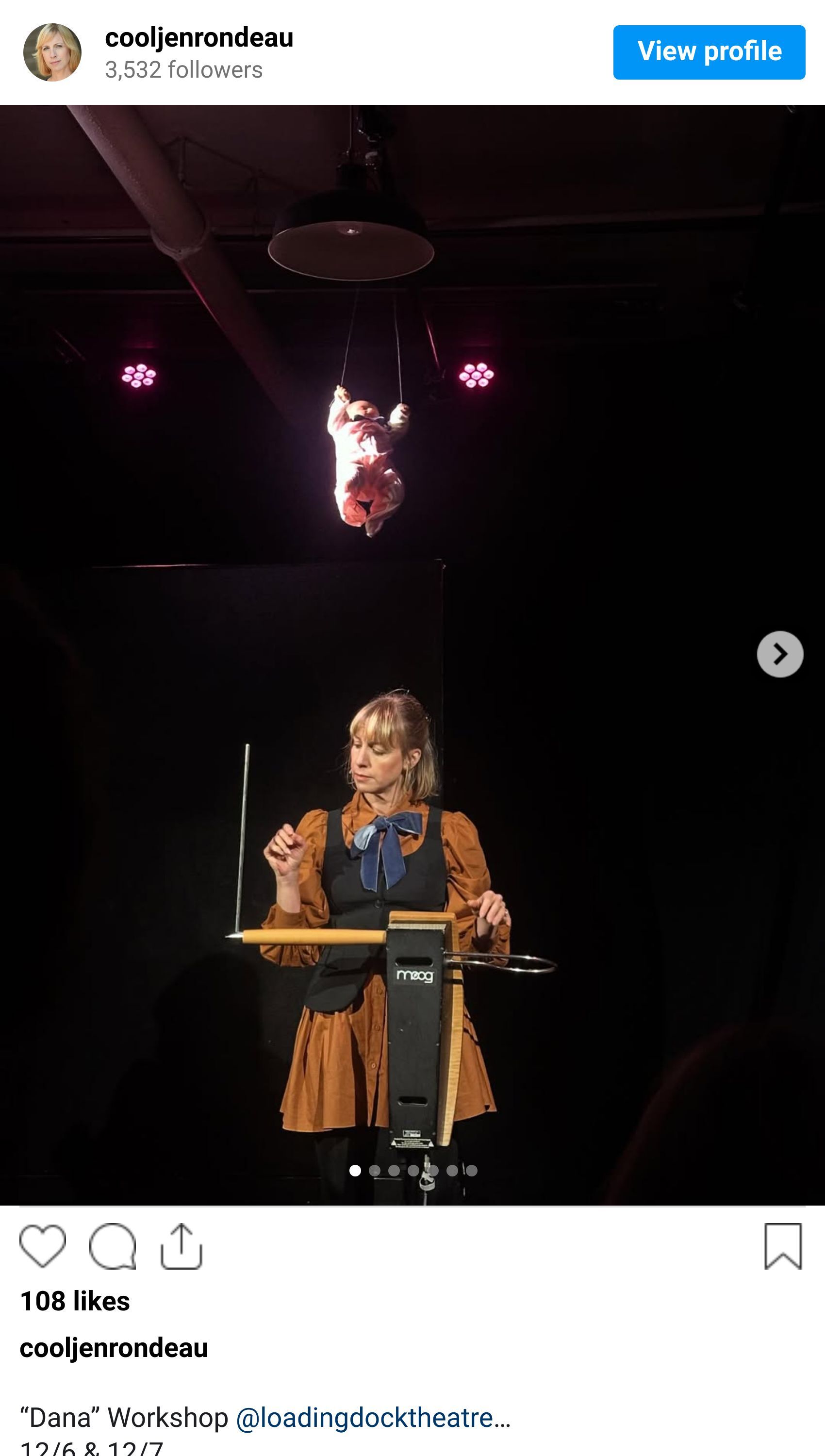
Rondeau, who was doing improv at the time, promptly bought a theremin and used it in comedy shows. She also became a student at Mannes School of Music extension program, where she focused on the theremin.
Here’s her advice for those looking to get their theremin on.
“Just think of it like any other instrument,” she said. “If you’re going to pick up a violin, you're not going to get good at it [right away.] But if you want to get better at it, then you just have to work harder… it sounds terrible when you start.”
Learning to play the theremin, however, is notably different than learning to play another instrument. “It’s like reading music if you’re a singer,” Rondeau explained. “You’re not consciously aware of where a note is in space… with a stringed instrument, you can put your finger on the string, but you can’t do that with a voice or a theremin.”
How you feel can also affect your playing. “I do feel like when my energy is less grounded, I'm not as good,” she said. “I feel like if your body is regulated, then you're standing still and you can control it better.”
And perhaps most importantly, Rondeau notes that there isn’t much music out there composed with the theremin in mind. “New thereminists: compose your own!”

Kerrice Brooks as SAM playing the theremin in Star Trek: Starfleet Academy
Screenshot: Paramount+
A theatrical spectacle
Ultimately, the theremin is meant to be performed, not just heard. Instruments you can play by physically touching it can create similar sounds, and are often what we hear these days on scores with floaty, otherworldly music. But the experience of playing a theremin is so unique, so off kilter from what other instruments are like, that it endures.
It’s why artists like Dorit Chrysler get showcased in The New York Times and why the New York Theremin Society, an organization she co-founded, has been around for over 20 years. It’s why the instrument keeps popping up in pop culture over a century after its invention.
And it’s also why it seems to regularly pop up in the visual medium of television, like we saw this week when Brooks played one in Star Trek: Starfleet Academy.
“That instrument taught me so much about connection,” Brooks told me after she confessed that the first time she tried playing a theremin, it didn’t work because her anxious energy “was literally taking up the entire room.”
She added, “I wanted to try to play it in rehearsal [for the episode]. There were too many images around me, so I could not play it… it will literally tell you exactly how you feel. Seriously, it’s magical. I think about it so often.”
Thanks for reading! If you’re looking for more Starfleet Academy stuff, check out my interview with co-showrunners Alex Kurtzman and Noga Landau about “Series Acclimation Mil” on Reactor magazine.
Any specific part of this post you’d love me to dig deeper on? Reply to this email and let me know!